
Data Journalism Insights
LEDE Times · Research & Data Journalism
Counted, But Not Covered
A year inside Pakistan’s two oldest newsrooms shows religious minorities entering the news mostly when they are under attack — and even that attention falling unevenly across communities.
📄 Read the original research (PDF)of all minority-related coverage centred on the Christian community — even though Hindus are Pakistan’s largest religious minority by population.
stories, across both outlets and twelve months, dealt with minority health, education, jobs or living standards.
of Nawai Waqt Urdu’s 36 minority stories carried a reporter’s by-line, against 63% at Dawn English.
01 — The Problem
Pakistan’s newsrooms went digital. Its minorities didn’t get the coverage to show for it.
Pakistan’s news media has grown steadily over the years, and today the country has a large mainstream press alongside a fast-expanding digital presence — blogs, vlogs and podcasts included. According to Data Reportal, Pakistan’s digital footprint keeps climbing: nearly half the population was already online at the start of 2024, with 111.0 million internet users recorded at that point. On paper, that gives news outlets enormous room to cover more, and more specifically.
But that growth hasn’t translated evenly across every subject the press covers. News coverage of religious minorities is one clear gap. Reporting on these communities tends to be biased or thin, partly because minority audiences are small and outlets chasing majority readership have little commercial incentive to invest in the beat, and partly because when minority issues do surface, many newsrooms remain cautious or silent rather than risk a reporting angle that could be seen as taking sides.
Religious minorities in Pakistan — including Christians, Hindus, Ahmadis, Sikhs and others — live with limited human-rights protection relative to community standards, and are underrepresented in the media or covered only in a narrow slice of their actual concerns. This despite forming more than 3% of the national population: per the Pakistan Bureau of Statistics’ 2021 report, the country is 1.27% Christian, 2.14% Hindu, 0.09% Ahmadi Muslim and 0.02% other minority faiths.
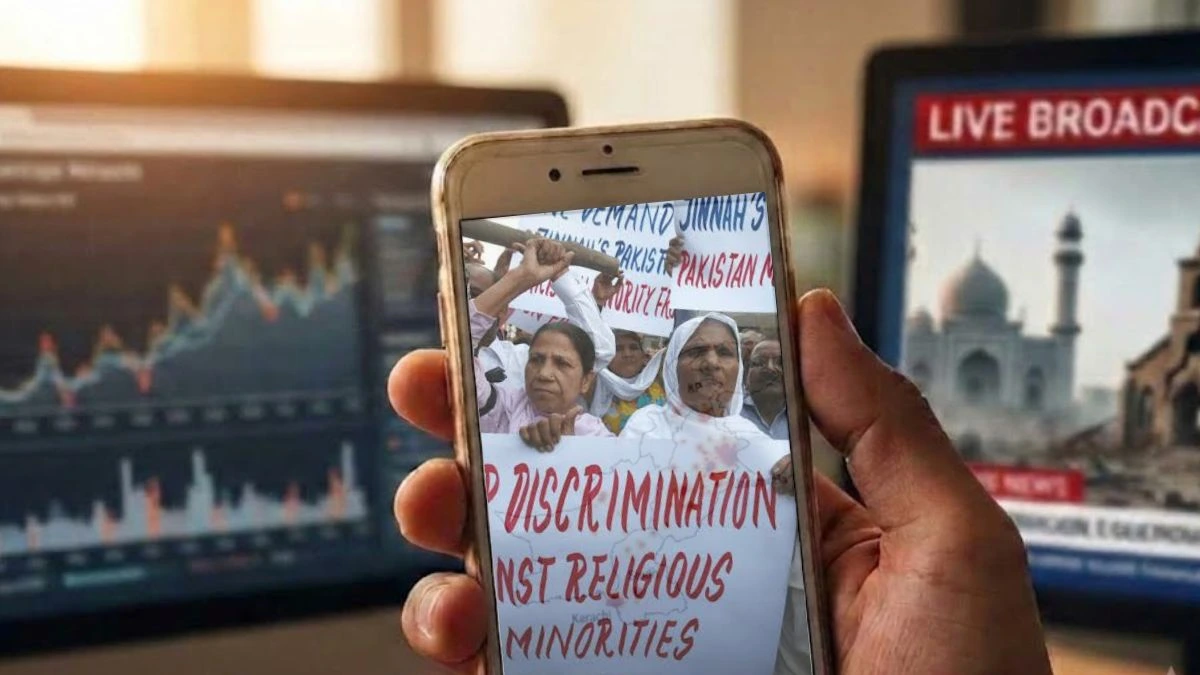
Most coverage arrives only when minorities are attacked — a church or temple burned, a mob descending on a neighbourhood. There is little reporting on their education, healthcare, employment conditions, lifestyle or broader human development. Newsrooms themselves lack diversity, with few journalists drawn from minority backgrounds, which feeds a shallower understanding of these communities in coverage decisions. Self-censorship and government censorship further narrow what gets reported on sensitive minority-related topics. This study examines twelve months of that coverage in close detail.
02 — Operational Definitions
How this study defines its terms
Minority
Religious groups that are minorities under Pakistan’s constitution: Christians, Hindus, Ahmadis, the Sikh community, and others.
Human Developmental Story
Coverage of health, education, job conditions, living standards, or any other human-development factor affecting minorities.
General Violence Story
Any attack on a minority individual, whether verbal or physical, not tied specifically to a place of worship.
Religious Factor Story
Attacks on temples, churches, or religious sites by a mob or group — any direct or indirect assault on minorities’ religious sentiments.
Other-Side Story
Anything minority-related that doesn’t fit the categories above — a follow-up to an earlier story, a political development, a press conference, or general social activity.
03 — Research Questions
What this study set out to answer
The research asks which news outlet gives more coverage to minorities in Pakistan, what kind of stories dominate that coverage, and how it breaks down by language, city, community, and format. Content analysis was used to identify, gather and analyse the underlying data.
- What kind of news on minorities is covered in both English and Urdu media?
- What is the length of coverage on each platform — and which platform talks more on a given topic?
- Which medium covered the most minority-related news over the past year?
- How many stories carried a reporter’s by-line, and how many were general web stories?
- From which city were minority-related stories reported most over the last 12 months?
- Which minority community received the most coverage during that period?
- How many stories were new, and how many were follow-ups to previous stories?
- Was the affected party typically an individual, or the minority community as a whole — across both outlets?
04 — Methodology
Content analysis, two outlets, one year
This study uses content analysis, a method well-suited to gathering data and sorting it into tables that reveal relationships between findings. Data was gathered through online research — searching minority-related keywords (Christian, Hindu, Ahmadi, Sikh) and manually reviewing the web links of news outlets.
Two of Pakistan’s most historic newspapers were selected, one English and one Urdu: Dawn, founded by Quaid-e-Azam and among the country’s oldest English-language papers, and Nawai Waqt, an Urdu paper with a storied role in the Pakistan Movement. Both were launched in the 1940s. A full year of coverage was collected and coded for each — recent enough to reflect current newsroom behaviour, and long enough to be analytically sound.
Keyword search
Christian, Hindu, Ahmadi, Sikh — across both outlets’ web archives
Manual review
Every matching story read and verified by hand
Coding sheet
Each story logged: city, by-line, community, format, length, angle
Cross-analysis
Tables compared across outlets, language, and time
05 — Data & Findings
93 stories, two newsrooms, twelve months
Toggle between outlets to see how coverage differs — or stays the same.
Story angle — what the coverage is actually about
Human-development stories cover health, education, jobs and living standards. Religious-violence stories cover attacks on places of worship. Everything else — general violence, follow-ups, political and social stories — sits in between.
By-line vs. unattributed
Whether a named reporter’s by-line was attached to the story, or it ran as a general web report.
New story vs. follow-up
Whether the report broke new ground, or continued an already-running story.
Which community got covered
Share of minority-focused stories, by community named in the report.
Where the story was reported from
Top cities named in the dateline. Jaranwala — site of the August 2023 mob attack on Christian homes and churches — rivals Islamabad’s press-conference-driven coverage almost single-handedly.
Population share vs. coverage share
Among Pakistan’s four largest recognised minorities, Hindus are the most populous — yet Christians receive by far the most media attention, driven almost entirely by one incident. Bars compare each community’s share of the minority population against its share of the 93 stories analysed (both outlets combined).
View the full coding sheets — Table 1.1 (Dawn) & Table 1.2 (Nawai Waqt), 93 rows
Table 1.1 — Dawn English (57 stories)
Table 1.2 — Nawai Waqt Urdu (36 stories)
06 — Conclusion
The coverage that isn’t there
Pakistan’s media coverage of religious minorities is limited and often biased. The stories that do get covered rarely touch the social, economic or human-development side of minority life. Attention arrives almost exclusively when a minority’s religion or sacred places come under attack.
Despite some effort, coverage remains inadequate, and many stories go unreported altogether. That silence has consequences: the social status, economic standing and human development indicators of these communities keep slipping, year over year, partly because the press isn’t watching. Newsrooms should invest in closing this gap — improving minority representation and ensuring their concerns actually reach the authorities meant to address them.
07 — References
Sources
- 00Original Research — full academic paper this article is based on: Minorities-in-Pakistan-and-News-Media-Research.pdf
- 01Pakistan Bureau of Statistics — Census: pbs.gov.pk
- 02Data Reportal — Digital 2024: Pakistan: datareportal.com/reports/digital-2024-pakistan
- 03Munshey, M. & Zahid, H. (2017). Inequality and Discrimination faced by Religious Minorities in Pakistan: ohrh.law.ox.ac.uk
- 04Religious minorities overlooked in Pakistan’s mainstream media, The News (TNS): thenews.com.pk
- 05Narratives of Marginalization, The News (TNS): thenews.com.pk
- 06Pakistani Press Towards Religious Minorities, GSSR Journal: gssrjournal.com
- 07Pakistan’s top rights group raises ‘alarm’ on religious freedom, Al Jazeera: aljazeera.com
- 08Nawai Waqt (Urdu): nawaiwaqt.com.pk
- 09Dawn News (English): dawn.com